|
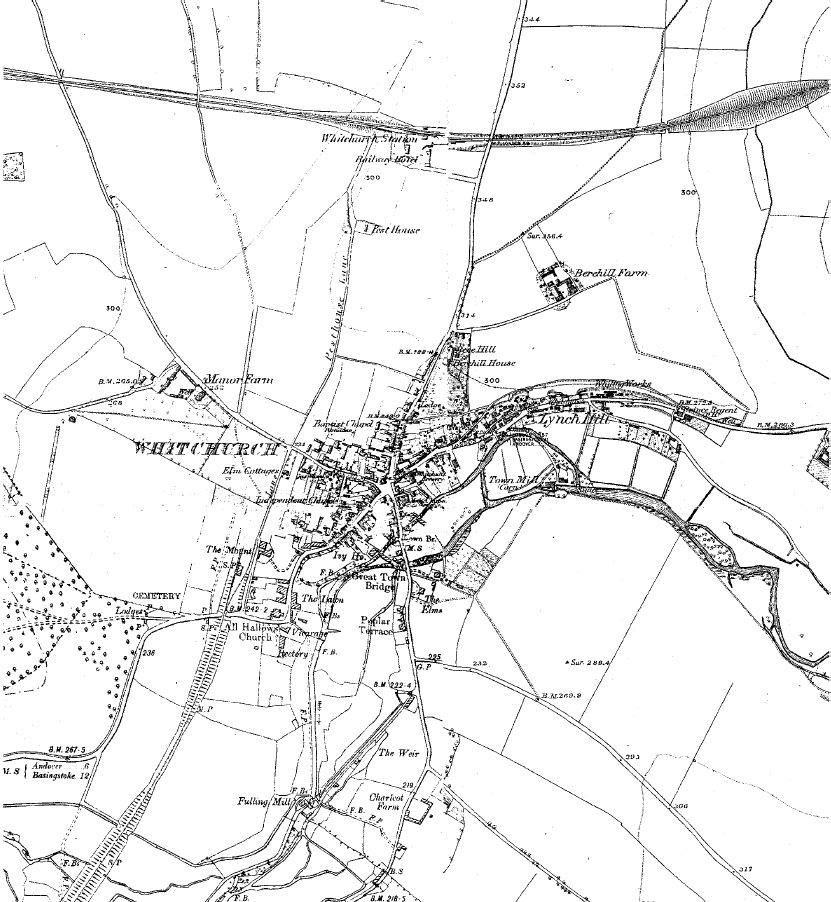
Whitchurch is set at the head of the Test Valley, the river rising just to the East of the town. It rises from the chalk and flows over a wide shallow gravel bed from its source through the town where it splits and passes through 4 mills and under several bridges from which can be seen large and numerous trout through the clear water. It and its banks are a Site of Special Scientific Importance (SSSI), see the map here. The Town is bounded to the North and West by the the North Wessex Downs, an Area of Outstanding Natural Beauty, this is also shown on the same map; the area has its own website.
It is easily accessible by bus and train or road, being just off the A34, midway between Newbury and Winchester, see the on-line map.
It stands on the site of a settlement dated around 400 BC, there are also remains of Roman settlement. The name may originate in "White Church" based on the belief that the earlier church was built of local hard chalk. An alternative is from Whitcerce meaning Place of proclamation. The Doomsday Book records that, amongst other facts, "it answered for 33 hides, land for 33 ploughs. 42 villagers, 50 smallholders and 10 slaves; 3 mills at 40s; meadow, 15 acres; woodland at 40 pigs. Value £35." There is more on the town's history here.
A large part of the town is a conservation area and contains many listed and notable buildings, these are shown here. The town's mills include Bere Mill which was built by the Portals family in the 18th Century when they started their now world famous paper business. Near the centre of the town is the Silk Mill, Britain's only working Silk Mill, which was built in 1800. It is open for visitors, 7 days a week with a display of items made from the silk and frequent exhibitions of silk related items; during the week you can see silk  being made on the 19th Century machinery. A new (Autumn 2009) signed route takes visitors around 2, 3½ or 4½ mile routes covering the mills and sticking as close to the River Test as possible, you can download a brochure here. being made on the 19th Century machinery. A new (Autumn 2009) signed route takes visitors around 2, 3½ or 4½ mile routes covering the mills and sticking as close to the River Test as possible, you can download a brochure here.
In the centre of the town is the old coaching inn, the White Hart, dating back to 1461, but now right up to date with wireless internet access for those staying or just visiting for a coffee.
The town's church, All Hallows, continues the tradition of there being a church in the town since the 9th Century and in the meadow opposite is the old Tythe Barn. There are some excellent photographs on the Astoft website.
Whitchurch's most famous resident, Lord Denning was born
right in the centre of town above the old draper's shop opposite the White Hart.
His last home, The Lawn, houses his huge collection of law books which is
available to lawyers and law students by arrangement with his son Professor
Denning. Next in line must come Richard Adams, author of Watership Down which is situated about 6 miles North-East of the town, for a map visit this site.
The town contains several good eating
places, pubs, or, if you are just passing through, four take-aways. If you want to
stay then there are several options from town centre hotel to B&B in the
countryside, details are here.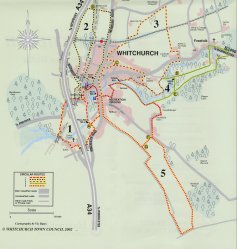
The town and surrounding area a worth viewing and a leaflet
showing 5 circular walks ranging from 1 to 5 miles in length will take you past
most of the points of note in the immediate vicinity. Full details of the walks
are here. Those outside the town have documented
interesting walks such as a 'Wessex
Walk' which covers the the centre of the town, the mills and the upper
reaches of the Test and the Saturday Walkers' Club routes to Andover and, via the mills, to Overton. For those taking up residence, Whitchurch Ramblers organises mid-week evening walks in the Spring, Summer and Autumn, it has marked maps for a series of walks, many with picture slide shows.
For those interested in cycling there are 2
Hampshire County Council brochures for cycle routes north of Whitchurch, a 17
mile (11 mile short version) tour of the Watership Down
area and a more strenuous 23 mile covering a large area north of Whitchurch.
They describe the routes in detail, which include off-road sections. The rides can start and finish at Whitchurch
railway station, train times can be downloaded here, with
refreshments at any of the hostelries in the town. Further routes are on Cycleroute.com - 24 miles from Whitchurch to Hannington, Ashmansworth and back - mainly offroad farmtracks so you should be fit to start this one!); 60 miles through Overton, Kingsclere, Hungerford on country roads - not a short one!; 36 Miles through Worthy Down, Sparsholt, Stockbridge and Wherwell
Major events in the town include the Hampshire Potato Days, held
on the last weekend of January when over 1,500 keen gardeners from all over the
South of England visit to select from nearly 150 varieties of seed potato.
Being a location with easy transport access several groups also use the town as a venue for their events, the Hampshire and Berkshire Poultry fanciers and 4 different regional dog groups run hold their shows at Testbourne Community Centre. Throughout the Summer events are held in the Millennium Meadow, a conservation
area on the South-West edge of the town which includes a Site of Special
Scientific Interest; details of the events are to be found in the Events Diary.
Just to the East of Whitchurch on the Basingstoke road
(B3400) is the little hamlet of Freefolk which houses the Watership Down pub,
the plant nursery of Chelsea Gold Winning Hardy's Plants (open to the public
Mar - Oct), its own church and a picturesque terraced row of thatched cottages, which are
frequently seen on Christmas cards, chocolate boxes etc.
|